
Citrus County Release Date Types
Florida uses several date concepts that should not be merged. The public FDC active-inmate detail labels its forecast Current Release Date. Florida law calls the computed state-prison date a tentative release date. Section 944.275 defines that term as the date projected from gain-time granted or forfeited. A released FDC record may later display an actual Release Date and a latest Date Out-Custody. Those fields look back at an event rather than forward to an estimate.
A maximum sentence expiration date starts with the sentence or combined sentences and lawful credit. The tentative date reflects credit then awarded, restored, or lost. It cannot be later than the maximum expiration date, but it can move. A pretrial detainee at Citrus County Detention Facility has no sentence-derived date. Bond, court rulings, holds, and release processing control that person's next event.
Scheduled vs actual: Current Release Date is a forecast for FDC custody; Release Date and Date Out-Custody document a past state event.
| Date or status | What it means | Best source |
|---|---|---|
| Current Release Date | FDC's visible forecast, subject to change | Active Inmate Detail |
| Tentative release date | Statutory state calculation based on gain-time | FDC calculation and §944.275 |
| TO BE SET | FDC review is pending | Current active detail |
| SENTENCED TO LIFE | No ordinary computed release date is shown | Current active detail |
| Actual Release Date | Historical end of that FDC custody episode | Released inmate detail |
Run a Citrus County Lookup
The correct route depends on whether the Citrus case is county, state, or federal custody. FDC does not hold the short CoreCivic jail calculation. CoreCivic does not calculate an FDC prison sentence. A county court order can explain jail credit and legal authority, but the docket is not the physical exit log. Start with the last known custodian and keep each system's date label intact.
- For a state prisoner, open the FDC Offender Search menu and choose the active-inmate search. Search by DC number or exact name.
- Open the matching detail. Compare the photograph, aliases, DC number, identity data, offense county, case, and sentence before using the displayed Current Release Date.
- For a person at Citrus County Detention Facility, call CoreCivic at 352-527-3332. Ask whether the person is pretrial or sentenced and how to obtain the existing calculation or release record.
- Use Citrus SCORSS to read the sentence, jail-credit language, bond, docket entries, and later orders. Do not treat an order time as the door-exit time.
- If the jail record names FDC, USMS, BOP, ICE, or another jail as the receiving agency, move to that agency's system. Transfer is not release to the community.
- After the event, confirm the actual date in the release record. FDC's released search is the state route; CoreCivic's booking/release record is the county route.
The broader Citrus County released-inmate lookup can help trace a transfer when the date record names another custodian. A no-result should not become a negative conclusion. Name variants, update timing, restricted records, and different custody systems can all explain absence.
Citrus County FDC Release Field
The live FDC interface should be quoted by its current label. Its public active detail uses Current Release Date and warns that the date can change due to gain-time awards, forfeitures, or review. When the field reads TO BE SET, FDC has not published a finished forecast. A life sentence may show SENTENCED TO LIFE. Neither phrase should be converted into an estimated calendar date.
The official FDC active-record example shows the public layout used for a state release-date lookup.
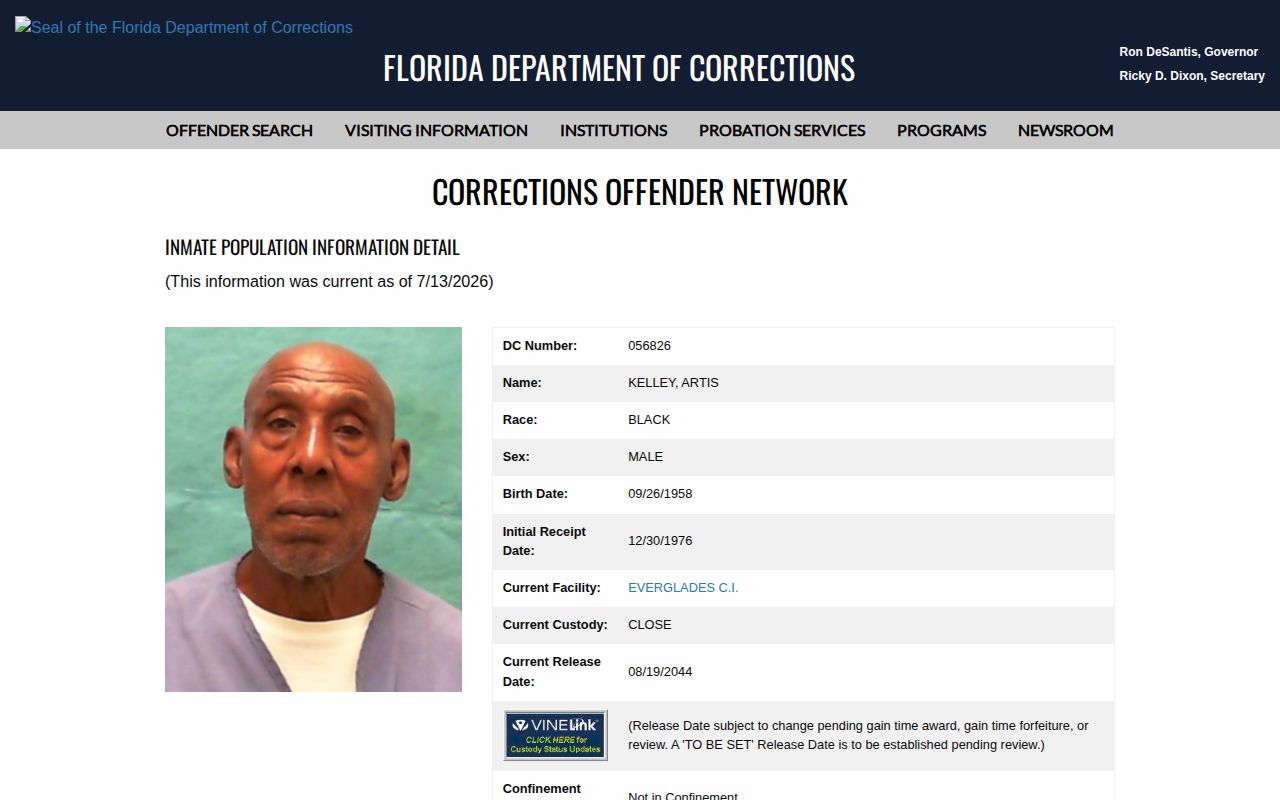
The capture shows why a reader should preserve the exact field text and check date instead of restating the forecast as guaranteed.
For an already-released state prisoner, use the Inmate Release Information Search. It is updated nightly and can show the historical release date, stated residence when public, sentence history, detainers, and incarceration periods. A preserved custody classification on an old detail is not proof of current prison custody. Read the Release Date and latest Date Out-Custody together, then check any active community supervision.
Note: FDC's state record does not contain a Citrus County-only jail sentence that never became a prison commitment.
Florida State Release Date Credits
Florida Statutes §944.275 is offense-date sensitive. Basic gain-time of ten days per sentence month applies only to offenses committed from July 1, 1978 through December 31, 1993. Incentive gain-time rates vary across later periods. For offenses on or after October 1, 1995, the statute permits up to ten days per month for eligible prisoners. The words "may grant" matter. Incentive credit is not automatic, and some offense groups are excluded.
The statute also addresses meritorious credit for an outstanding deed or service and a possible educational award for a qualifying credential, each within eligibility limits. Serious-offense exclusions and offense-date changes make a hand calculation unsafe. FDC must account for sentence structure, court credit, awards, forfeitures, discipline, and new terms.
For the post-October 1, 1995 incentive cohort, §944.275(4)(f) bars gain-time from producing release before at least 85 percent of the imposed sentence is served. Court-awarded credit for physical incarceration counts toward that floor. Section 921.002 reinforces that Criminal Punishment Code rule. The percentage is a minimum-service rule, not a promise that release will occur at exactly 85 percent.
The capture below comes from the official Florida Legislature gain-time page for tentative release dates.
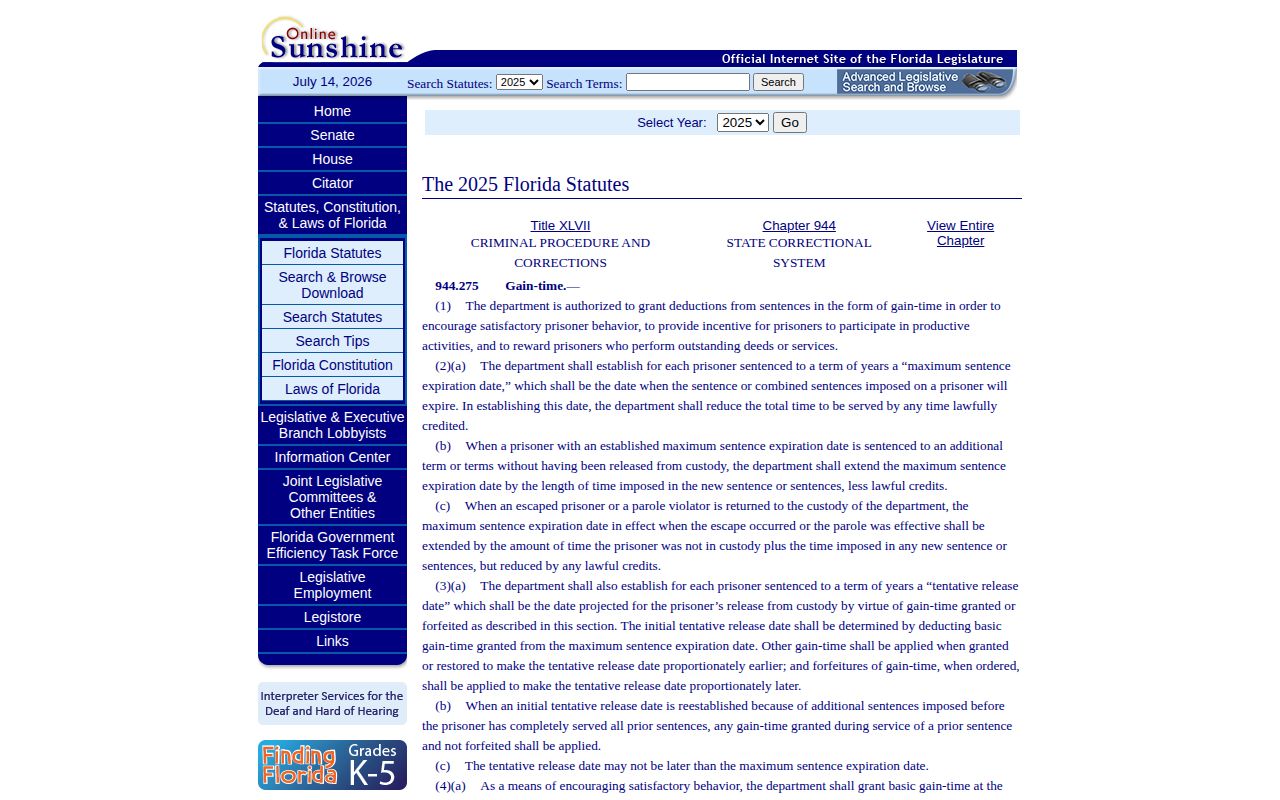
Its date-sensitive terms show why one broad formula cannot replace the current FDC calculation.
Citrus County Good Conduct Rule
The 85-percent state-prison rule must not be transplanted to a Citrus County jail sentence. Florida Statutes §951.21 provides a separate county good-conduct framework. It says a board of county commissioners may discontinue or revise county credit. If authorized, the statute states maximum monthly rates by years served and permits possible extra good time within its terms. Those ceilings do not prove Citrus County's current policy or a particular person's award.
A sound Citrus County release date requires the actual local policy, the court's jail-credit award, the sentence, and CoreCivic's calculation. Research found no public Citrus calculation policy that supports an online estimate. Discipline or a revised credit decision may affect a sentenced county prisoner's date. A pretrial person remains outside this sentence-credit framework entirely.
This difference is the county-specific release-date issue most likely to cause error. State and county custody can exist in the same case sequence, but their credits come from different rules and different record keepers. Ask CoreCivic for the maintained record. Do not apply an FDC calculator to CCDF time.
Note: County good-conduct law sets a framework, but only Citrus policy and the maintained calculation support an individual date.
Citrus County Release Date Changes
A release forecast can move for reasons that arise from the sentence, institutional record, court, or another agency. Changes do not always move the date in the same direction. A restored award can move a state tentative date earlier. A forfeiture, added sentence, or correction can move it later. A detainer may leave the recorded date intact yet change where the person goes next.
| Factor | Possible effect | Record to check |
|---|---|---|
| Gain-time award or restoration | May move an eligible FDC date earlier | FDC calculation history |
| Disciplinary forfeiture | May move the tentative date later | FDC gain-time and discipline record |
| New or corrected sentence | Can change maximum and tentative dates | Court order and FDC sentence structure |
| Concurrent or consecutive term | Changes the combined calculation | Judgment and FDC record |
| Detainer or receiving agency | May change destination, not necessarily the sending date | Release sheet and receiving locator |
| Parole or FCOR action | Applies only to an eligible case and may set or alter a release process | Written FCOR action |
Florida law also permits gain-time forfeiture for specified misconduct and possible restoration on a warden's recommendation. Escape or parole-violation time can affect a record. Because these inputs are person-specific, only FDC can give the authoritative state calculation.
Confirm Citrus County Actual Release
Do not use a forecast to claim that release occurred. For county custody, request CoreCivic's existing booking/release record with the person's name, date of birth, AR or booking number, and approximate dates. Ask for the date and time custody ended, legal basis, holds or detainers, and receiving agency if recorded. The Citrus Clerk docket can explain the order or sentence, but it usually cannot prove the physical exit minute.
For state custody, read the historical FDC Release Date and latest Date Out-Custody after the event. FDC's public released tables also cover a state cohort dating from October 1, 1997 and refresh monthly. That archive is useful for older Florida prison history, not for a county-only CCDF episode.
Florida VINE can send an agency-reported custody-change notice for a named person. It should supplement direct verification because a transfer, detainer, or later admission may follow. The Citrus County VINE check explains how to register and confirm the reporting agency. No official Citrus retention promise was found for old VINE release events.
Note: An agency-reported release event confirms that agency's change, not freedom from every possible state, county, or federal hold.
Citrus County Date Record Requests
When public fields conflict, write down the check time and exact language from each source. Prefer an actual dated event over a forecast. Prefer the custodian's release document over disappearance from a list. A court order may precede processing, while a VINE event may arrive before a durable copy is available.
The local source trail is divided by record ownership. The CoreCivic facility profile supplies CCDF's contact route, while the Citrus Clerk SCORSS guide explains access to the court case. CCSO keeps arrest and law-enforcement records, but its public-records page directs jail records to CoreCivic. Send each office only the part it maintains. An arrest date can identify the episode, a court order can explain legal authority, and the jail release record can establish when CoreCivic custody ended. Reading those dates as separate facts prevents an arrest date or order date from being mistaken for the actual release date.
For an FDC discrepancy, Admission and Release lists 850-488-9167 and dc.release@fdc.myflorida.com. A focused public-record request can seek the sentence structure, maximum expiration date, tentative or Current Release Date history, gain-time awards and forfeitures, actual date out, and detainers for one DC number. For a county calculation, call CCDF at 352-527-3332 to obtain CoreCivic's current submission process because no Citrus-specific online form, price, response time, or retention rule was verified.
Ask for existing records, not a newly created prediction. That distinction follows Florida's public-record framework and keeps the request tied to a date the custodian actually maintains.