
Where Citrus Detention Facility Releases Go
A release from Citrus County Detention Facility ends CoreCivic's custody for that booking episode. It does not always mean the person walked into the community. Bond, recognizance, dismissal, acquittal, a court order, or completion of a county sentence can lead to community release. A prison commitment sends the person to the Florida Department of Corrections. Other records may name a county jail, the U.S. Marshals Service, BOP processing, or another custodian.
The destination field matters as much as the time. A transfer is a release from the sending jail but continued custody elsewhere. Ask for the release basis, any hold or detainer, and the receiving agency. Then switch to the named agency's locator. If the record shows community release, the Clerk docket can explain the bond, sentence, or order that authorized it, although the docket does not prove the exact door time.
| Recorded path | Next confirmation |
|---|---|
| Bond or court-ordered release | CCDF release sheet plus Citrus Clerk docket |
| Florida prison commitment | FDC Offender Search and admission record |
| Federal movement | Federal docket and USMS or later BOP record |
| Another local custodian | The receiving jail or agency named on the transfer |
Confirm Citrus Detention Facility Releases
CCSO has no verified current-inmate or recent-release list for this facility. Its public ten-day PDF is an arrest report. A person can remain at CCDF after the report ages off, and the report can remain online after a release. Direct confirmation starts with CoreCivic, not with disappearance from the Sheriff's publication.
- Record the person's exact name, date of birth, AR or booking number, arrest date, and case number when available.
- Call CoreCivic at 352-527-3332. Ask whether the person remains held and, if not, request the recorded date, time, basis, and destination.
- Search the Citrus Clerk's SCORSS docket for the related order, bond entry, disposition, sentence, or later court action.
- If the release sheet names a transfer, use the receiving agency's search. FDC Offender Search covers a state commitment; federal court and USMS lead until a BOP placement occurs.
- Use Florida VINE as a supporting custody-event source for a named person, not as a certified jail release sheet.
A missing name is not release proof. Obtain the CCDF event and read its destination before deciding where the person went.
Access Citrus Detention Release Channels
Citrus County has no single public portal that combines arrest, jail, court, and transfer records. Each channel answers a different part of the CCDF release question. Online, the CCSO ten-day arrest PDF can supply an AR number and other identity clues, while SCORSS can supply the case history. Neither source is the jail's current roster or release log. Florida VINE can add an agency-reported event for one person, but it is not a certified record.
The phone channel is essential. CoreCivic can address the county jail episode, while FDC Admission and Release addresses a later state-prison commitment. In-person court access may help when a SCORSS document is not immediately viewable. The Clerk has service locations in Inverness and Crystal River, but it cannot confirm physical jail custody. Call CCDF before going to the facility because no public walk-in records schedule was found.
A formal request should identify the existing record and a narrow period. If CoreCivic does not provide the record by phone, ask for its current Citrus submission procedure. CCSO's online form and published fees apply to sheriff-held material, not to a CoreCivic release sheet. A broad request can create delay or cost without isolating the date, basis, detainer, and receiving-agency fields that resolve the release.
Note: The ten-day CCSO publication limit applies to its web arrest report, not to the underlying CCDF release record's retention.
Resolve Citrus Detention Release Conflicts
Different sources update on different clocks. Write down the time each source was checked and preserve its exact wording. If CoreCivic reports a release while VINE still shows custody, ask for the recorded event time and recheck the notification feed. If the arrest PDF still lists the person, remember that it is a rolling arrest history. Continued publication does not show continued custody.
A court order may authorize release before staff finish processing it. Another case or detainer may also prevent community return. Match the CoreCivic booking number and dates to the Clerk case rather than merging same-name people. Compare date of birth, case number, photograph, and any agency identifier. When the jail record names a receiving agency, that destination controls the next lookup even if a less precise source says only "released."
An erroneous field should be challenged with the office that created it. CCSO handles a sheriff arrest-report issue, CoreCivic handles the jail release record, and the Clerk handles docket indexing under court procedure. Send the disputed field, the claimed correction, identifying details, and the supporting order or official document. Sealing and expunction are separate legal processes and should not be treated as ordinary error correction.
Request Citrus Detention Release Records
CCSO expressly directs jail-record requests to CoreCivic because the Sheriff does not operate the detention facility. No Citrus-specific online CoreCivic form, fee, response deadline, public retention rule, or walk-in records schedule was verified. Call first and ask for the current submission method. A narrow request for an existing record is more useful than a demand for all information about a person.
Citrus County Detention Facility
2604 W. Woodland Ridge Drive
Lecanto, FL 34461
Phone: 352-527-3332
Fax: 352-527-6561
Call before traveling; public records counter hours were not published.
Ask for the booking and release sheet or its equivalent for the named episode. Include known identity details and a tight date range. Request the recorded release date and time, legal basis, holds or detainers, and destination or receiving agency. These are requested fields, not a promise that every field exists. If a photograph is needed, specify the jail-held booking image rather than a sheriff-created arrest photo.
Citrus Detention Facility Custody Profile
CCDF is a private, multi-level county jail operated by CoreCivic. It holds Citrus County pretrial and sentenced people, but physical location does not identify legal authority. Verified federal detainees have also been housed there while awaiting trial, sentencing, or BOP designation. CoreCivic also refers to U.S. Virgin Islands partners. A search must therefore follow the authority named in the person's record.
The 2023 PREA audit classified the site as a private-for-profit jail. Its figures were a designed capacity of 791, a then-current population of 553, and a prior-year average daily population of 675. Those dated audit numbers describe the review period. They are not current occupancy or release counts.
Federal Releases from Citrus Detention Facility
A March 2026 U.S. Department of Justice release verifies that CCDF housed federal detainees awaiting trial or sentencing in the Middle District of Florida. Charging records also described people awaiting BOP designation. For this group, leaving the county jail may mean USMS movement rather than freedom. There is no public USMS name locator. The federal docket, facility confirmation, and the responsible federal office control until BOP receives a sentenced person.
Once a person enters BOP custody, the BOP locator can show a register number, location, and release date. A BOP result marked released means only that BOP no longer holds the person. It does not rule out local, state, or immigration custody or federal supervised release. CoreCivic's general ICE reporting information does not prove a current ICE contract or population at CCDF. Follow ICE only when the actual release record names that agency.
Note: A federal detainee housed in Lecanto may remain under federal authority even though the building is the county detention facility.
Citrus Detention Facility Release History
CoreCivic's facility history says CCDF has served Citrus detention needs for nearly 30 years and describes a faster-turnover jail setting rather than a state prison. That distinction helps explain the local records split. CCSO documents the arrest, CoreCivic manages the jail episode, and the Clerk records the court authority. State and federal agencies take over after a qualifying transfer.
The same facility description lists life-skills work, faith services, self-guided anger management, and Go Further reentry planning. These programs may support transition, but the public material does not state that every released person participates. Current release hours, exit doors, property-return steps, weekend practice, and family waiting rules were not published. Ask the facility rather than relying on another jail's routine.
The official CoreCivic facility profile shows the operator and contact details used here.
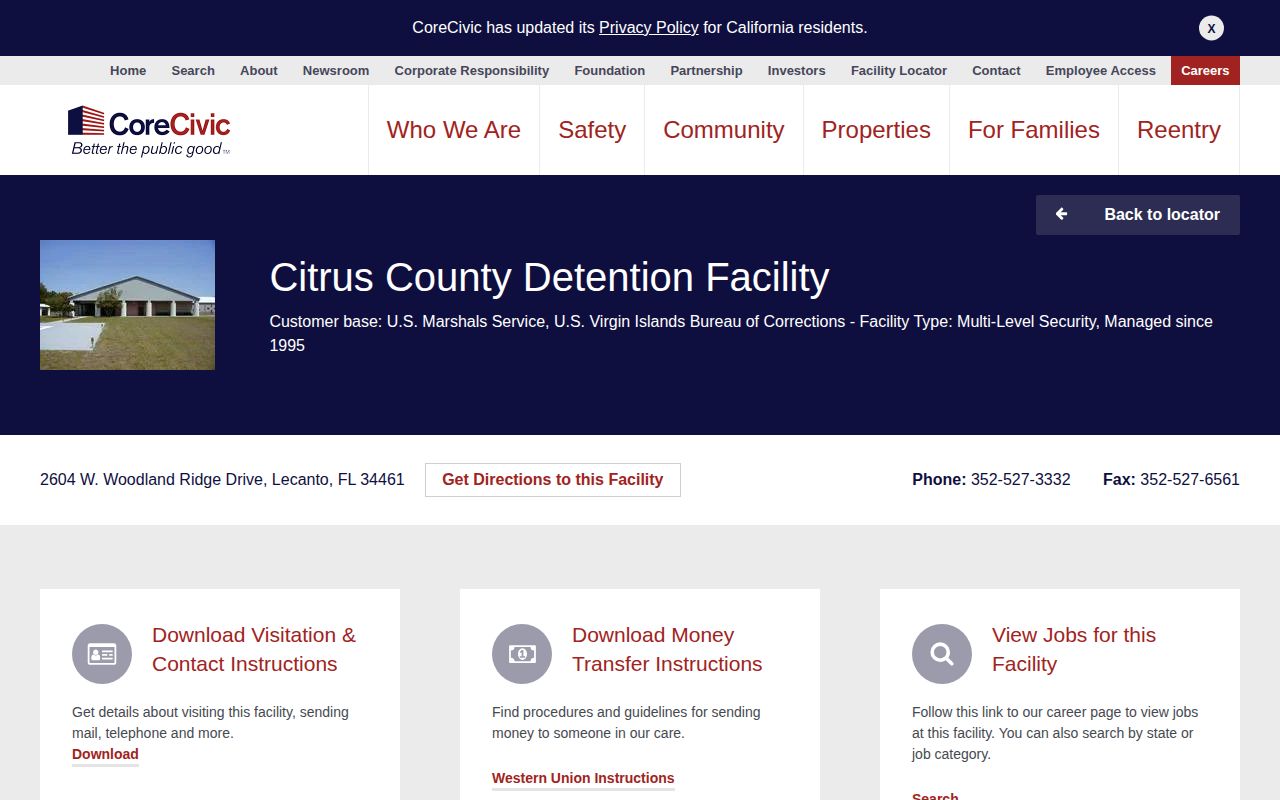
The profile confirms that the facility, not CCSO, is the direct starting point for a jail custody or release question.
Read Citrus Detention Release Fields
A release record should be tied to one booking episode. Identity, AR or booking number, and arrest date establish the episode. The release date and time show when CoreCivic stopped holding the person. The basis explains whether the change followed bond, a court order, completion of time, or transfer. Holds and the destination show whether another agency still claimed custody.
- Release
- The end of one custodian's control, which may be community return or transfer.
- Detainer
- A request or claim from another authority that can prevent a direct community release.
- Transfer
- Movement to another custodian while confinement continues.
- Time served
- Completion of the jail time recorded for the sentence, subject to other holds or cases.
Use the Citrus County released inmate search and records path when the last custodian is uncertain. It separates county, state, and federal sources and explains how to reconcile a court order with the physical release event.
Note: A booking photograph identifies an episode but does not establish release, transfer, present custody, or the final result of the case.