
Citrus County Parole and Probation
Probation and parole are not two names for the same Citrus County release status. A court imposes probation as a sentence or part of a sentence. Florida Department of Corrections, or FDC, supervises state probation cases in the community. Parole is discretionary release before sentence expiration for a limited legacy prison population, and the Florida Commission on Offender Review, or FCOR, administers the parole decision. Conditional release is another statutory form of post-prison supervision for qualifying serious or repeat offenders. The safest practice is to copy the exact Supervision Type shown on the FDC detail.
A person may leave the Citrus County Detention Facility with no FDC supervision, with a probation term, or by transfer to another custodian. A bond release does not create parole. A state-prison release also does not prove parole because many Florida prison terms end through sentence expiration or conditional release. CoreCivic's county release record establishes how its custody ended. The FDC community record establishes whether state supervision is active.
| Status | Who sets it | Best public check |
|---|---|---|
| Probation | Court sentence | FDC Supervised Population Search and court docket |
| Parole | FCOR for an eligible legacy case | Written FCOR action, then FDC supervision detail |
| Conditional release | Statutory post-prison process | FDC supervision type and FCOR record when applicable |
| No state supervision | Custody or sentence ended without an FDC community term | Release record and latest court or FDC detail |
- Probation
- A court-ordered community sentence supervised under stated terms.
- Parole
- Early release for a limited parole-eligible prison population, subject to FCOR conditions.
- Discharge
- The documented end of a supervision term or custody obligation for that agency.
- Absconder
- An FDC status for unknown whereabouts and unavailability for supervision with a violation warrant.
Verify Citrus County Supervision
Start with FDC's Offender Search menu. It separates prison custody, released-prison records, supervised population records, and absconder records. That split matters. A released-prison result can preserve an old custody classification and prison history, but the Supervised Population Search answers whether an FDC community term is current. Neither search covers a person whose only sentence was Citrus County jail or a locally administered county matter.
- Identify the person with the full name and DC number when known. A Florida DC number has six characters, either all digits or one letter followed by five digits.
- Check the Inmate Release Information Search for the prison release date, aliases, county and case details, and the latest date out of custody.
- Open the FDC Supervised Population Search. Name searches use prefixes, so compare the full detail rather than trusting one result row.
- Read Supervision Begin Date, Current Location, Current Status, Supervision Type, and Scheduled Termination Date exactly as displayed.
- Compare the FDC county and case with the Citrus Clerk docket. A court order supplies legal context, while FDC supplies the current state supervision record.
- If the record conflicts with a recent jail event, call the listed FDC office and ask whether a later admission or transfer changed the status.
Important: A released FDC record and an active supervision record can both be correct because prison custody and community supervision are different states.
Florida VINE may report a custody event for a participating jail or FDC, but it is not the supervision database. A VINE release notice belongs to the reporting agency and may be followed by a transfer or a supervision term. Use the detailed FDC record for Citrus County post-release supervision and the originating agency's release document for the custody event.
Citrus County Supervision Status
FDC status words have specific meanings. ACTIVE means direct community supervision. ACTIVE SUSPENSE means the person is temporarily unavailable for direct supervision, often because the person is in jail or another facility while the officer follows the case. ABSCONDER means the person's whereabouts are unknown, the person is unavailable for supervision, and a violation warrant has been issued. None of these labels should be rewritten as a guess about the person's physical location.
The Scheduled Termination Date is the expected end shown in the supervision record, not proof that discharge has already occurred. A new court order, violation proceeding, transfer, or correction can change the record. The Current Location field is the best lead for the responsible office. Verify the latest detail and ask FDC for the formal discharge record when the precise end of supervision matters.
Note: FDC community status does not by itself confirm the end time of a prior Citrus County jail stay.
Citrus County Supervision Office
Citrus County's named FDC supervision point is Office 053 in Inverness. It is part of Circuit 5 and Region 3. Circuit 5 also covers Hernando, Lake, Marion, and Sumter counties. That five-county structure is why a Citrus conviction does not guarantee that the Inverness office holds the current file. Residence, assignment, transfer, or another case may place supervision elsewhere. Follow the public detail's Current Location field before calling.
FDC Office 053, Inverness
1630 US Highway 41 N
Inverness, FL 34450-2409
Phone: 352-560-6000
Fax: 352-860-5155
The FDC Circuit 5 office listing is the source for this local routing. Its page also identifies Circuit 5 administration in Bushnell at 4416 S. Highway 301, phone 352-609-6105, and tavares.cir@fdc.myflorida.com. For statewide community-supervision questions, FDC Field Services lists 850-717-3444 and co-supervision@fdc.myflorida.com.
The official FDC office capture shows how Citrus County sits within the wider circuit and why the live assignment controls contact.
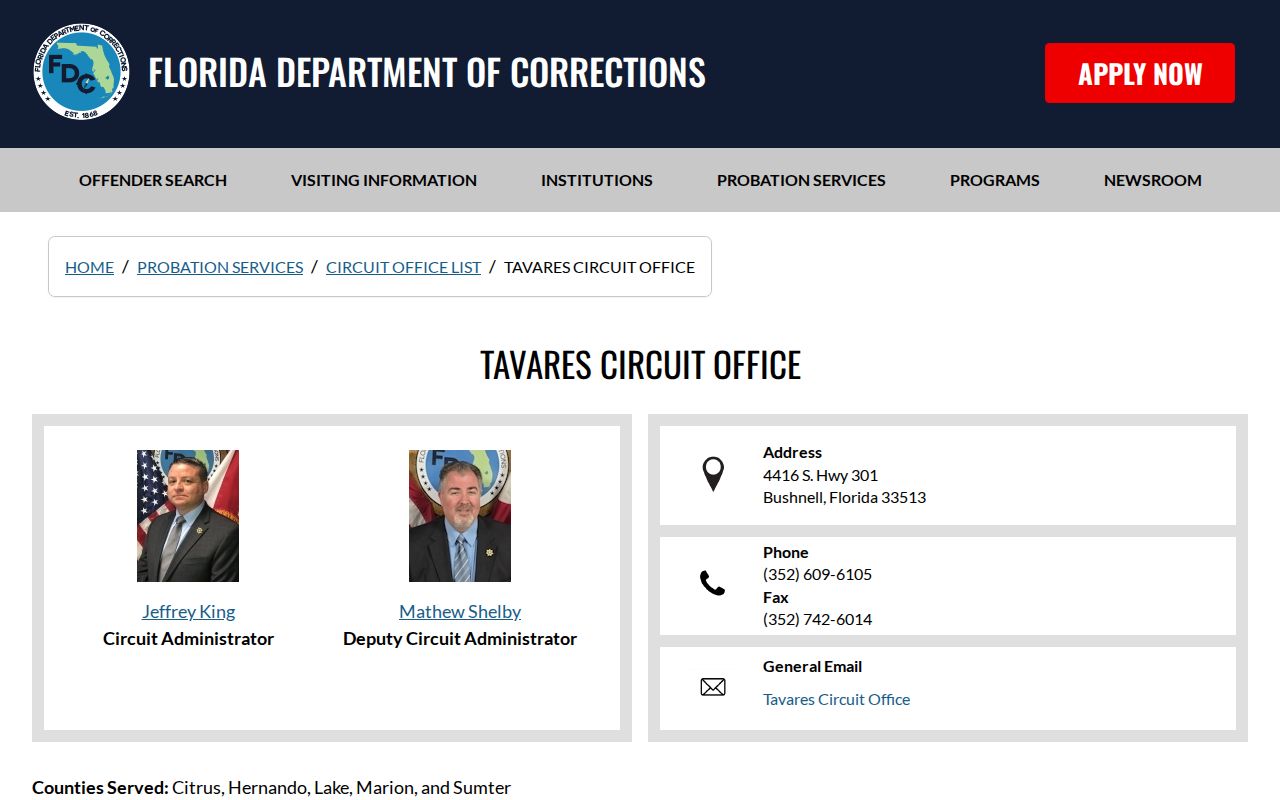
The page identifies the Inverness point while preserving the circuit-wide context needed to route a supervision question.
Citrus County Parole Hearings
Most modern Florida prisoners should not be promised a parole hearing. Florida effectively ended parole for most crimes committed on or after October 1, 1983. Remaining eligibility depends on offense date and narrow legacy categories. FCOR administers those parole cases and certain other release decisions. Section 947.16 supplies different initial-interview periods for otherwise eligible people, but the phrase "unless otherwise provided by law" is vital. Eligibility must be checked against the offense date, governing law, and FCOR file.
The FCOR voting schedule says in-person parole hearings normally occur Wednesdays, with video or telephone access, and remote follow-up sessions may occur Thursdays. The month schedule controls. Agendas list items such as name, DC number, category, county, offense, and case number. An agenda proves scheduling only. It is not a grant, denial, release, or revocation result.
No public searchable post-hearing decision database was verified. The authoritative result is the written Commission action or order. Request it from fcorlegal@fcor.state.fl.us or 850-848-4460 with the name, DC number, meeting date, county, case, and desired action. The Commission Clerk lists 850-488-1293. Later FDC release and supervision details can corroborate what happened, but agenda disappearance cannot.
FCOR's official release information describes the limited parole framework shown in the capture below.
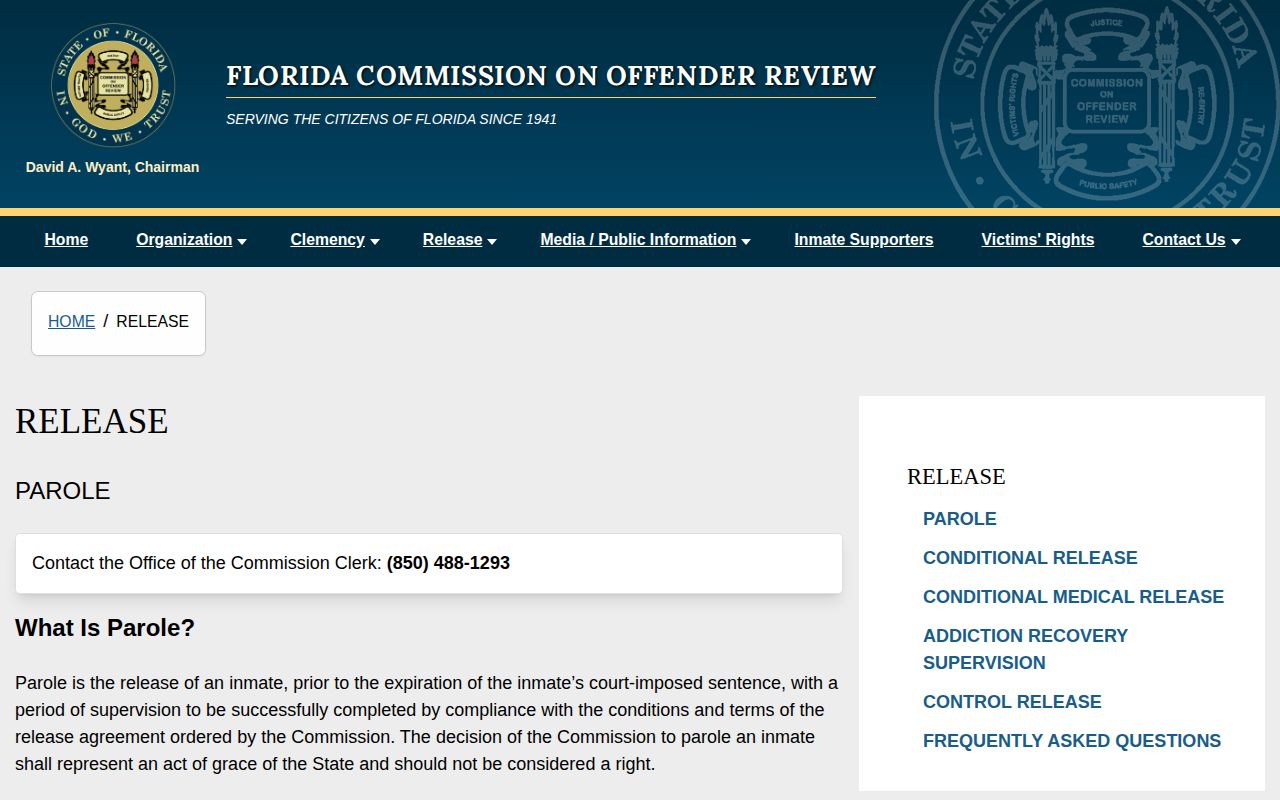
The distinction between parole eligibility and a final written action prevents a calendar entry from being mistaken for release approval.
Citrus County Absconder Records
Florida maintains a separate Absconder/Fugitive Search. FDC says that database refreshes weekly, while termination and location changes refresh nightly. A result should be matched by name, DC number, identity details, case, and county. The Absconder Unit lists 850-717-3475 on weekdays from 8 a.m. to 5 p.m. A public result is a lead for the responsible agency, not a way to resolve or clear a warrant.
The Citrus County Sheriff's Office Wanted of the Week archive often includes probation violations and failure-to-appear notices. Some entries later receive a Captured mark. It is a curated publicity list, not a full warrant system, and absence does not establish that no warrant exists. For an FDC supervision case, the FDC absconder detail and agency confirmation control.
Note: ACTIVE SUSPENSE and ABSCONDER are different FDC statuses and must not be treated as interchangeable.
Citrus County Reentry After Release
CoreCivic identifies Go Further reentry planning, life-skills work, and faith services at the Citrus County Detention Facility. These jail programs may help someone prepare to leave custody, but participation does not prove an FDC supervision term or change the legal status shown in the release record. The release basis, court order, and FDC record still control.
Zero Hour Life Center's CORI material describes individualized case management, links to community resources, and peer-recovery support. Its listed address is in Ocala, so it is accurate to call it a regional resource rather than a Citrus County office. A person under supervision should also confirm any travel, residence, or program requirements with the assigned officer before relying on a regional service plan.
Citrus County Supervision Discharge
Supervision ends when the responsible authority records completion, termination, or another lawful disposition. The public Scheduled Termination Date is a forecast field. It does not replace the final FDC entry or formal discharge record. If an exact end date is needed, save the latest supervision detail and request the existing record from FDC with the DC number, case, and date range.
A court docket may show an order that affects probation. FCOR holds the written action for a parole case. FDC maintains the community-supervision status. CoreCivic holds the prior county jail release record. The Citrus SCORSS court search can supply the case order, but not the jail exit time. These sources answer separate questions, so they should be reconciled rather than collapsed into one label. For the broader custody and release-document path, the Citrus County released-inmate search explains how to follow the last custodian without treating transfer as community release.
Florida public-record law requires access to nonexempt existing agency records, subject to statutory restrictions and redaction. A narrow request for the discharge or status record is more useful than asking an office to create a narrative. Ask for the record by name, DC number, case, supervision type, and approximate termination date.
Note: A scheduled termination date remains a forecast until FDC or the responsible authority records the supervision discharge.